A personal essay for adult readers about sexuality, shame, and writing.
I set out to write dragons, magic, political betrayal, and a love story involving three people.
Somewhere along the way, I began joking that I was giving myself an unaccredited PhD in sex.
Apparently, the dragons were the easy part.
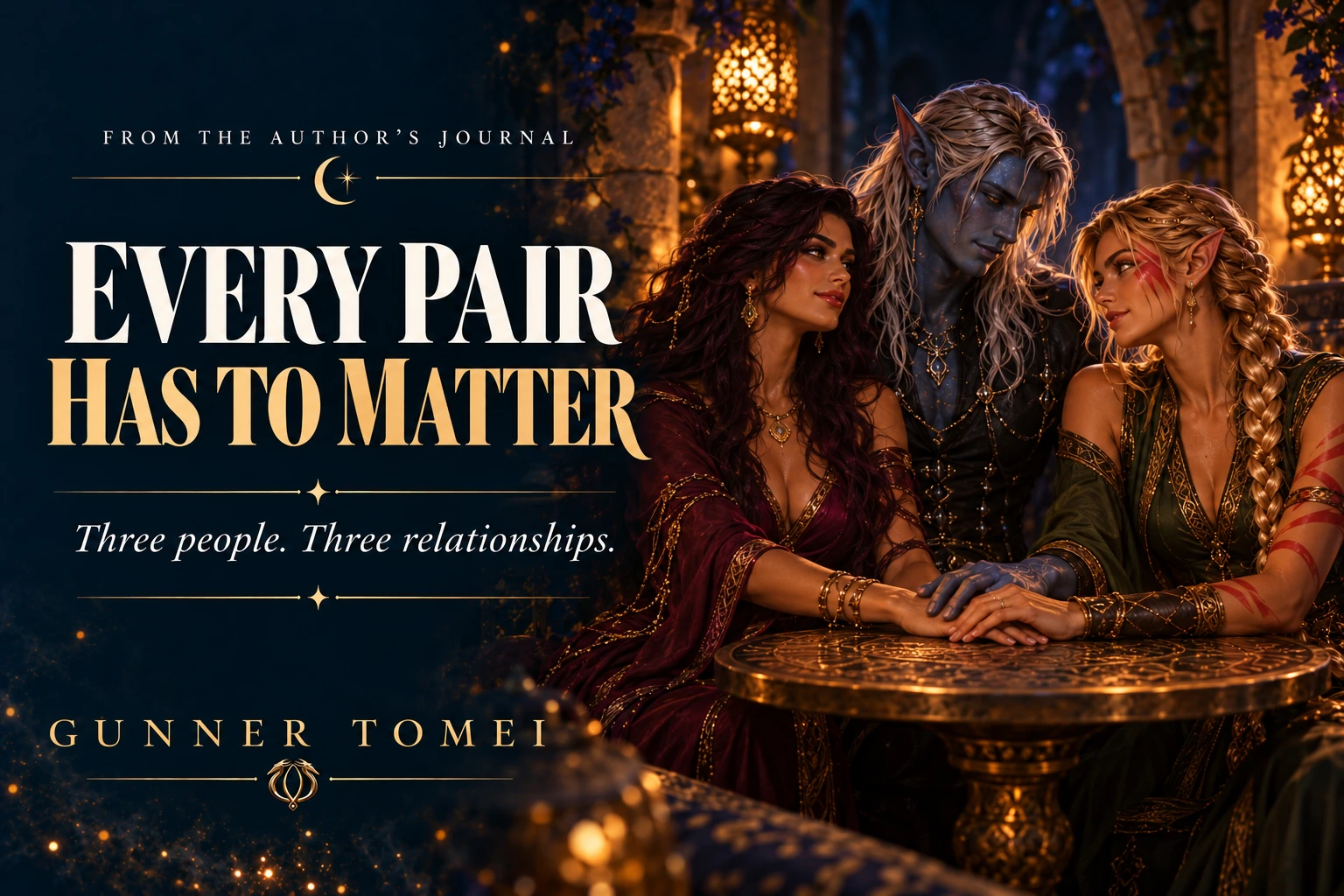
I wanted to write three-person relationships that felt like relationships. I did not want an established couple with a decorative third person added for heat. I wanted every person to love and be loved as a complete human being. I especially did not want the two women connected only through the man between them.
That forced me to learn the word dyad. A dyad is a relationship between two people. In a fully connected triad, there are three dyads, plus the relationship the three people create together. Each pair needs its own history, attraction, conflict, private language, and reasons to choose each other.
I had never lived in a triad myself. Imagination could take me only so far.
My process became a kind of method acting. I spent enormous amounts of time inside my characters’ heads, especially the women. I asked what each person noticed, desired, feared, misunderstood, and had been taught to hide. I tried to feel the emotional logic of their choices from inside them.
That immersion did not give me authority over someone else’s lived experience. It gave me better questions. Research and listening had to test my answers.
I began studying anatomy and physiology, which are related but different. Anatomy is the structure of the body. Physiology is what the body does. Then there was psychology: the thoughts, expectations, memories, fears, meanings, and relationships that affect what the body experiences.
From there, the education expanded. Desire and arousal are not the same thing. A physical response is not consent. Orientation, gender identity, sexual role, and relationship structure describe different parts of a person. Polyamory is not simply group sex. A triad and a vee are not the same structure. Top and Dominant are not synonyms. Kink and fetish are not interchangeable terms, and neither is automatically a diagnosis.
I had fully settled into middle age without being taught most of this.
Like a lot of people, I had received pieces of sexual education surrounded by silence, jokes, moral judgment, pornography, and guesswork. I had learned enough to function and not enough to understand. There were questions I did not ask because I feared that the answers might reveal something terrible about me.
The characters gave me a safe doorway. At first, I was asking for them.
What does surrender mean when someone chooses it? How can a person want control in one moment and want to give it away in another? Why can being trusted with another person’s pleasure feel so powerful? What is the difference between enjoying a toy, having a kink involving toys, and having a fetish?
Eventually, the questions stopped belonging only to the book.
Toys have always fascinated me. Their designs, mechanisms, and possibilities can be erotic. So I began asking more precise questions. Was it the object, the control, the orgasm, or something underneath all three?
The toys carried real erotic charge, but not independently of what I imagined they could make possible with a partner. My wife’s pleasure affected me with or without them. Leading could be fulfilling. So could following her exact direction or being invited simply to witness.
Underneath all of it was the same thing: being trusted with something private.
The language that fit was a pleasure top with a toy kink.
In kink terminology, a top is the person applying an action or sensation. That does not automatically make the person a Dominant. A pleasure top finds deep erotic satisfaction in creating and witnessing a partner’s pleasure. A service top enjoys giving a partner what they want, often by following their direction.
The distinction mattered because it revealed that control was not the center of my desire. Trust was.
I could finally understand what my own body had been telling me. There was a consensual erotic pattern centered on my wife’s agency, her pleasure, and the trust between us.
I had expected that understanding to leave me exposed.
Instead, I felt clean.
Because knowledge finally separated who I was from what shame had accused me of being.
That understanding changed the writing too.
I now understand that chosen surrender should increase a character’s agency rather than erase it.
Most of all, I understand why each dyad matters. Intimacy is the privilege of being trusted with a part of another person that the rest of the world does not automatically receive. A convincing triad requires three separate forms of that trust. The group cannot substitute for any missing pair.
We often talk about sex education as though it belongs only to young people and concerns only pregnancy, infection, and danger. Those lessons matter. So do the words adults need for desire, boundaries, roles, pleasure, and individual variation. Without language, people fill silence with guesses. Shame is always eager to supply the worst one.
I started this education because I wanted to write people unlike me with honesty. The characters opened the door. Research helped me walk through it. Somewhere inside their questions, I found language for myself.
The degree remains unaccredited.
The education changed my writing and my life.
Keep exploring the world.
The books of Breath, Blood & Chain →